Name in Print I: Arnulf, Dynasty, and Charters*
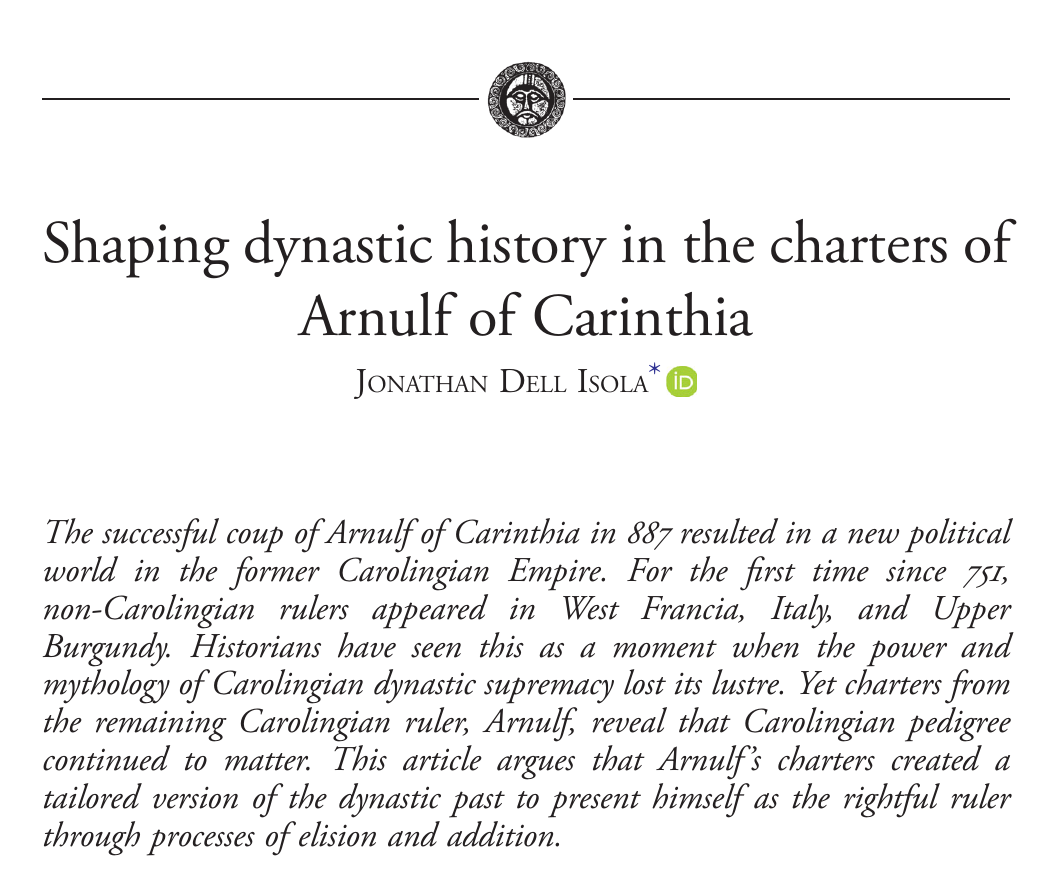
Recently my first article was accepted for publication in the journal Early Medieval Europe. If you have been reading Among the Ruins for a while it will be wholly unsurprising that my first article would be about two things: Arnulf of Carinthia and charters. Originally this material started its life as a conference paper I gave all the way back in 2018 at the New England Medieval Conference.
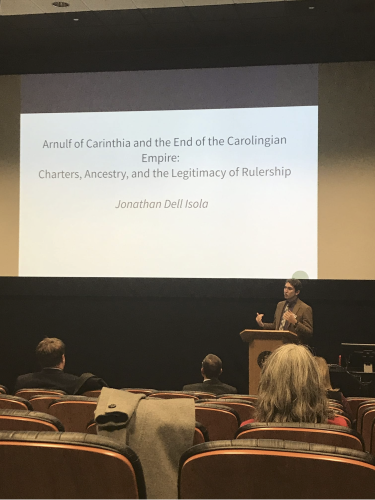
At the time I was really just starting to think about Arnulf as I moved through coursework, but one thing that struck me was the connections made in the charters between Arnulf and his predecessors.
Basically, Arnulf occupies a really weird spot when it comes to the Carolingians. He was an 'illegitimate' son (but I have views on that) who successfully overthrew his uncle and became king. This is pretty much unheard of, and soon after his coup in 887 you get a whole bunch of non-Carolingian kings, called the reguli in the literature. Historians see the coup as a pretty important break: if the assumption before 887 was that a king would be a Carolingian, that no longer held true.
If you know about the Carolingians you also know that they tended to name their kings the same things: Charles, Louis, Lothar, Carloman. Arnulf is pretty obviously not one of those names. Traditionally the argument is that proper Carolingians are given proper Carolingian names, because it signaled their status as a viable heir. In Arnulf's case the choice is ambiguous because he gets his name from the supposedly saintly ancestor of the dynasty, so it is both Carolingian and not, something that Eric Goldberg argues was part of the point.
So this all raises a question: if after 887 the mythos of Carolingian superiority was broken, did it matter for Arnulf? That is where my article hopes to contribute. In charters we often get confirmations of previous grants, and the charter will note the relationship between the person granting the new charter and the predecessor. So a charter might note Arnulf confirming a grant of "his grandfather king Louis the German." We might expect this, if Arnulf was just following past practice, but what we might not expect is this to be varying between places and times.
If you are enjoying this piece please consider subscribing as either a free or paid member and sharing on social media. Researching and writing these pieces takes time, subscribing lets me grow my audience and move towards making it sustainable long term. You can also donate or upgrade too.
What I mean is that Arnulf emphasizes certain of his relatives, for instance Louis II of Italy, in a way that creates a narrative. The charters serve to establish Arnulf's claim to the throne by casting him in a lineage of Carolingian rulers. In some charters we see a manipulation of who is mentioned, suggesting that there is some intention there. But it also implies that the people receiving the charters continued to care about the Carolingians as a signal for royal legitimacy. That Arnulf was a Carolingian set him apart from his rivals in Upper Burgundy, Italy, or West Francia.
This narrative might vary but serves the same overarching purpose: to make history end with Arnulf as the latest ruler. Whether this is direct continuity with his uncle or tying him into a longer Carolingian past, the goal was to represent his kingship as natural. The Carolingians had essentially created a fiction that only they could become kings, and non-Carolingians called this into question. But in some places, and at certain times, Arnulf's Carolingian status continued to matter. Accepting a charter that presented Arnulf this way, or requesting it even, meant incorporating and accepting this version of the past.
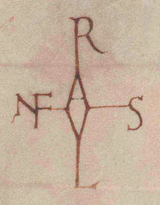
That is the first part of the article, in the second part I discuss a very rare phenomenon that never appears among Arnulf's predecessors. Normally, charters have the king's monogram at the end of the document as a way of authenticating them, but in certain cases we find someone has gone and added Arnulf's monogram to a charter of his grandfather, for instance. Here is what that looks like, taken from a charter now at St. Gall:
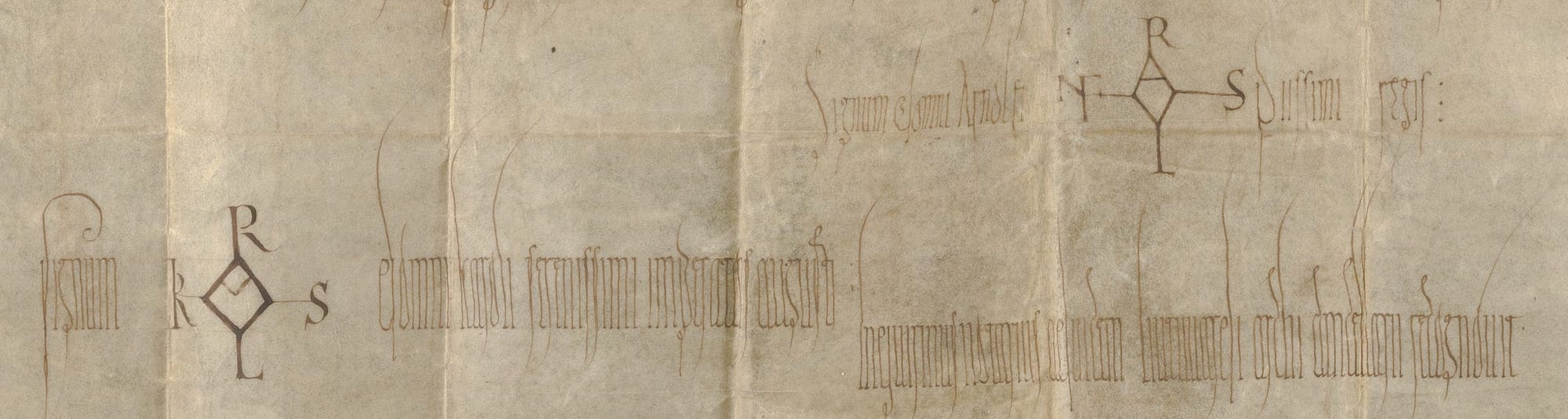
This is extremely weird, because charters are not exactly public documents after they are granted. So why add a monogram? I argue that they were put there as part of the ceremony for granting a new charter, as a way to bolster both grants. It does this by transporting Arnulf's authority back in time, so to speak, by placing his monogram onto these older documents. Once again creating a fictional version of the past, connecting Arnulf with his Carolingian predecessors.
This is all gesturing towards the continued vitality of the Carolingians as a political construct in the imaginations of European elites. While we know they lose out in the end, in the 880s and 890s that fact was not yet clear. So when we look at this period as a moment of transition, we need to understand it was not a clean break, but something more complicated.
You can read the article if you have access to the journal by going here. It is on early view now.
If you prefer you can also listen to the podcast episode I did discussing the article:
Thanks for reading Among the Ruins! If you haven’t subscribed, please do so below and you can have these posts delivered right to your inbox!
*I am shamelessly pilfering the name of this post from my friends over at The Historians' Sketchpad, who post lots of great translations and essays. Go check them out!