Should History Make You Uncomfortable?
Spend enough time on the internet and it's likely you've come across the sentiment that "history that makes you comfortable isn't history but propaganda." Sometimes it is expressed more bluntly as "history should make you uncomfortable."
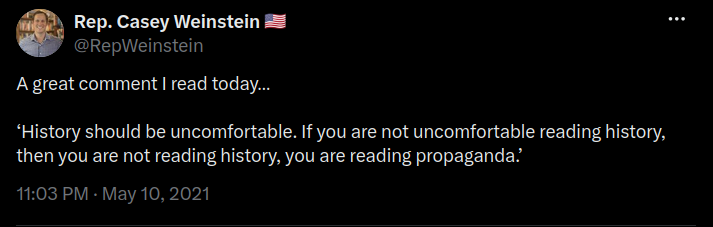
I've always been a bit frustrated by this perspective, indeed it often functions as a sort of thought-terminating cliche, and the 250th anniversary of the Declaration of Independence on July 4th seemed a good opportunity to put my thoughts on this somewhere. This is a very thorny question and I'm not claiming to have the final word here, but these are my thoughts as of July 2026. Maybe someday I will revisit this and find I've changed my thinking, and that isn't a bad thing!
This idea has proliferated in the context of bad-faith right wing attacks that history and social science courses teach people "to hate their history" or "feel guilty." The solution to this "revisionist" or distorted history is to teach "American Exceptionalism." From the 1776 Commission Executive Order: "in recent years, a series of polemics grounded in poor scholarship has vilified our Founders and our founding."[1] The solution is to teach history that deemphasizes race, slavery, gender, etc. and instead provides an education "in the principles of our founding that is accurate, honest, inspiring, and ennobling."
Now let me be clear about something: there is no "indoctrination" of students by teachers, and conservative students (those identifying as Republicans) overwhelmingly say they feel they belong at their respective institutions. Barely any (~2% of college students surveyed) feel they don't belong because of their political views.[2] So when national elites or think-tanks push the idea that colleges are hotbeds of institutional indoctrination, a charge with a long history dating to the Cold War!, it doesn't reflect much of the actual student experience at these places. Especially when so much of the national media overweights a few schools (Harvard, etc.) instead of where the vast majority of students are taught.
What critics see as "indoctrination" is really a shift in narrative. Whereas previously students may have been taught the inevitability of western "civilization" or the God-given superiority of America, historians now have tended towards a substantially more nuanced picture. What is nuance has been cast as denigration. All the teeth-gnashing about the "West" is generally based on an imagined past that didn't exist, and reacts to a historical method that undermines White supremacy. Teaching students about the horrors of slavery and its role in the US throughout history isn't the same as teaching them to hate the US or themselves. The critics-to-the-critics adopt the mantra of "history should make you uncomfortable" because, to them, too much history is taught as a sanitized and triumphant vision of (American) progress.
If you are enjoying this piece please consider subscribing as either a free or paid member and sharing on social media. Researching and writing these pieces takes time, subscribing lets me grow my audience and move towards making it sustainable long term. You can also donate or upgrade too.
The question boils down to whether history is meant to be moral. That is, does history exist to teach us something about the present? The past doesn't reveal an easily digestible moral lesson to the present no matter how much we might want it to. As Frederick Douglass recognized in his "What to the Slave is the Fourth of July?" (1852), one can have a complicated relationship to the past. Douglass charged that the promises of the Revolution rang hollow to those who were enslaved: "your shouts of liberty and equality, hollow mockery."[3] Should they have been told to simply be more inspired by the words of the Declaration?
Yet Douglass also believed that the Declaration contained "great principles" that could eventually be put into practice. The past, even an imperfect one, could serve as a source of hope. Saying history should be uncomfortable ignores that the past can be inspiring. The challenge is that no one person is in control of the past's interpretation. Two people can interpret the same event in drastically different ways. John Brown is a hero to some, a villain to others. Asking whether John Brown was a "good guy" is not a historical question, but a political one. Here John Brown is (usually) made to stand for a present political debate.

I don't mean this to say that history teaching needs to be "apolitical," which generally is impossible and reflects (usually) dominant political discourses, but that we need to be clear about why and when we interpret the past. This is also not the same as saying historians shouldn't have moral and political opinions (they do and should). Historians are free to draw lessons from the past and apply them to the present. That isn't a problem unless it distorts our understanding of the past. I know I am being a bit hair-splitting here, but my point is that historians and others should keep these questions in mind when interpreting the past. If you are thinking "that sounds hard to do!" then you would be correct; it is hard and there is no obvious boundary but as it was once said, "that's the discipline."
It is fine to take lessons from the American Revolution about tyranny, political power, or slavery and argue that it bears some relevance to the present. Yet we need to be cognizant that this will not be a perfect match between the past and present, and in looking at it from the perspective of how it relates to the present, we risk weighting the past with the moral values that we want it to have.
In general, weighting the past with moral debt isn't going to give us the absolution we want it to. That is, wanting the past to prove the wrongness (or greatness!) of something can be a way for us to abdicate responsibility. You don't need the permission of the past to think something is bad in the present. The past (as interpreted by historians) rarely has such a simple moral to teach us, and it is up to us to make decisions in the present about what we value, what we detest, and what we want changed. The past cannot tell us those answers, and it shouldn't be made to.
This is all to say, we can take both inspiration and horror from the past, but both risk distorting the past into something it is not. What happened in the past and what it means are fundamentally distinct questions. I don't mean that historians are simply there to recover "the truth" but that we will always engage in an act of interpretation. That interpretation is shaped by what we in the present need from the past. It is neither permanent or inevitable, but always shifting based on our ideas and interests. As Alan Elrod recently wrote in Liberal Currents: "the study of history and the craft of mythology are deeply intertwined because our understanding of the past is always about our understanding of ourselves in the present."[4] To say that everyone in the past sucked, or that it was better, can be important to us for some or other reason, but risks turning the people of the past into either villain stand-ins or mirror images of the modern person. Rarely do people in the past fit neatly into categories of modern debate. Indeed, we shouldn't even assume that the past is going to tell us something revelatory about the present! The real way history should make one uncomfortable is by proving nothing is immutable, nothing is simple, and nothing is perfect.
Thanks for reading Among the Ruins! If you haven’t subscribed, please do so below and you can have these posts delivered right to your inbox!
- https://trumpwhitehouse.archives.gov/presidential-actions/executive-order-establishing-presidents-advisory-1776-commission/↩︎
- "The College Reality Check: What Students Experience vs What America Believes," accessible here: https://www.gallup.com/analytics/644939/state-of-higher-education.aspx.↩︎
- Frederick Douglass, "What to the Slave is the Fourth of July?", accessible here: https://daily.jstor.org/what-to-the-slave-is-the-fourth-of-july-annotated/.↩︎
- Alan Elrod, "The New Vandals," Liberal Currents, July 25, 2026: https://www.liberalcurrents.com/the-new-vandals/.↩︎