Uncovering a Courtier II: Who was Eginolf the 'Beloved Orator'?

I spend a lot of time on Among the Ruins talking about kings and nobles, perhaps unsurprising given my academic background. Yet charters and other sources give us glimpses into people of a decidedly lower register. Our challenge as historians is usually that we have very little information about these people, here is one of them.
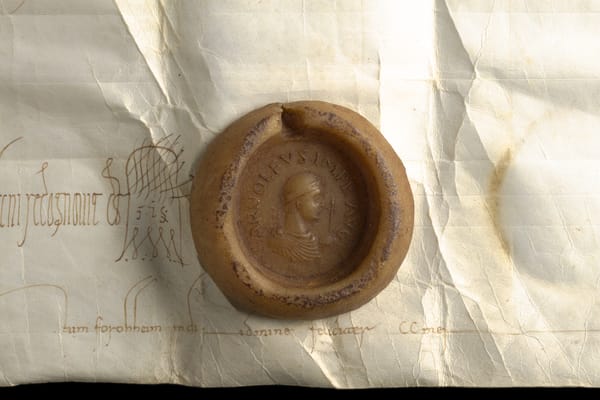
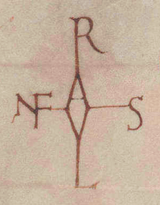
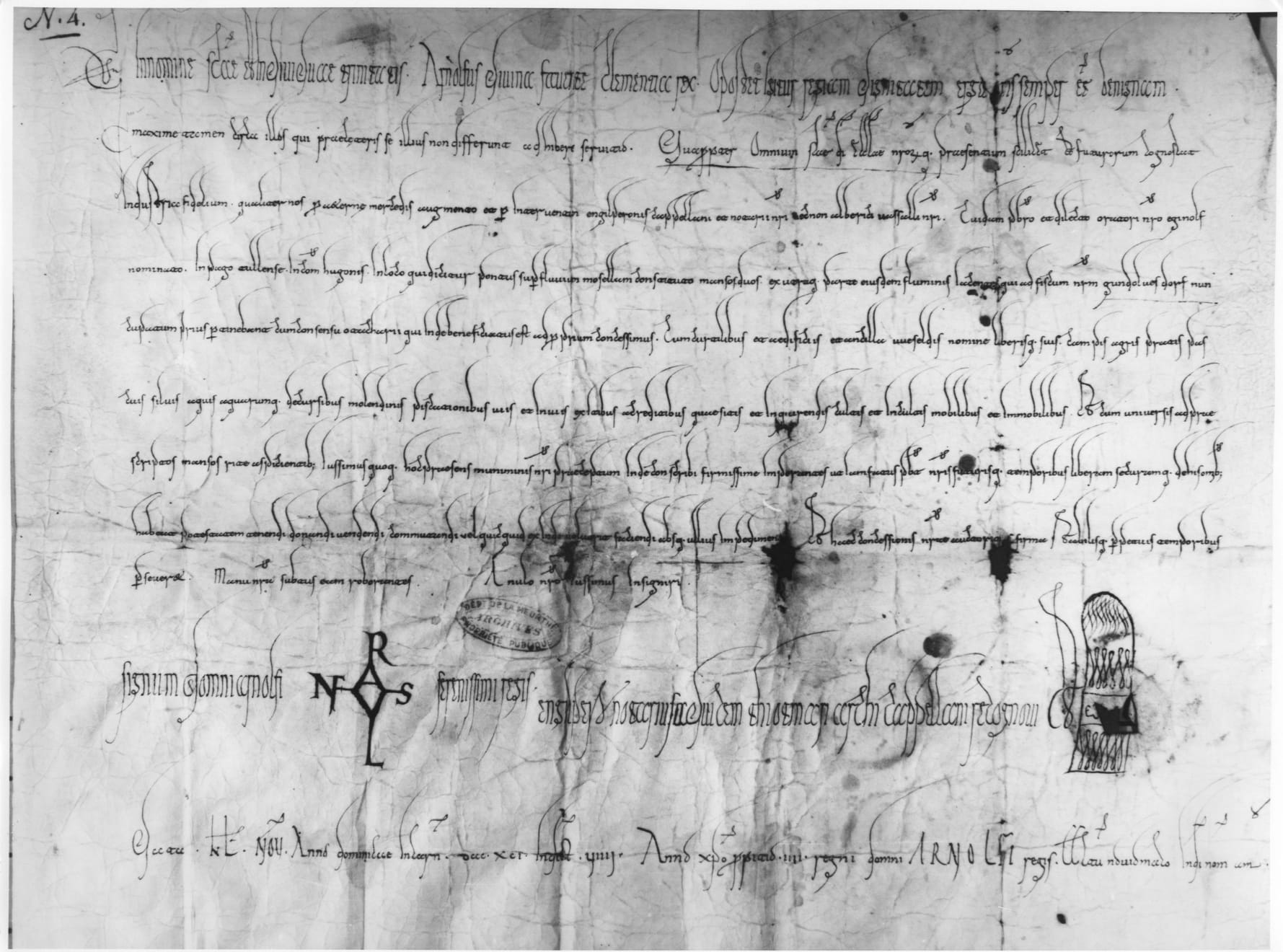
At the old palace of Nijmegen in late 891, Arnulf granted a charter giving land near the Moselle River to a priest named Eginolf. Arnulf had been in the region as part of a military campaign against the Vikings. The charter lets us know that Eginolf was not just a priest, but was described as "our beloved speaker" (dilecto oratori nostro). What does this mean? Why was he "beloved" and what role did a "speaker" serve here? There is no ready answer here, so how would a historian figure it out?
Defining Terms
First, we need to define our terms. An orator is usually what it sounds like: a speaker, or in many medieval contexts, someone offering prayers.[1] So does this mean Eginolf was someone offering prayers? Possibly, but it is very rare to find this in Carolingian charters.[2] The idea is strengthened, however, by another charter Arnulf granted to (another) priest named Isanpreht, who is also called an orator.[3] It may be better to translate orator here as something like "prayer-giver" instead of simply "speaker." It isn't clear, however, why you would need to note he was both a priest and an orator, unless (maybe) what Eginolf was doing was somehow unusual here. Thinking back to the context, a military campaign against the Vikings, perhaps Eginolf was saying prayers for the army or was involved in the litanies Arnulf ordered after the Battle of Leuven to celebrate the Frankish victory.[4]
The other descriptor, dilectus ('beloved'), was not a romantic term, as might be assumed, but was one indicating a close connection to the king. Only 33 individuals are called this in Arnulf's charters, and even fewer more than once (16).[5] So it seems our Eginolf was in pretty rarefied heights, but we have no other information about him besides this one charter. Searching for the name Eginolf in the digitized MGH reveals only three results for the 9th century, one of which is the charter above. For the other two: the first is a list of witnesses who helped mark out a disputed territory in the area near Regensburg, and the second is a charter of Carloman (Arnulf's father) that was granted on the intervention of a dapifer named Eginolf.[6] A dapifer was a court servant who, theoretically, served food to the king's table, but it may have been a more generic term of honor.[7] If Eginolf had served at Carloman's court in the late 870s, it is plausible he continued his service to Arnulf afterward, perhaps as a chaplain. A dapifer did not preclude another role, the only dapifer mentioned in Arnulf's charters is a count.[8] I'm not convinced these are the same person, however.
Sorry for the interruption! If you are enjoying this piece please consider subscribing as either a free or paid member and sharing on social media. Researching and writing these pieces takes time; subscribing lets me grow my audience and move towards making it sustainable long term.
The Intercessors
Further evidence comes from who asked Arnulf to make the grant. The charter was granted on the intervention of two men, Engilpero and Alberic. Engilpero was a notary working for the court but also Arnulf's "chaplain" (cappellani). Engilpero's involvement suggests a courtly connection for Eginolf. This was the only charter that Engilpero appeared as the intercessor, meaning there was probably some connection between the two that we can not fully recover. Alberic, is only described as Arnulf's vassal, but he is potentially the same man we can find killing the Lotharingian magnate Megingoz the following year in 892.[9] Alberic was thus probably a Lotharingian figure who was on campaign with Arnulf in Lotharingia, and intervened on behalf of Eginolf. Perhaps, then, Eginolf was a more local figure who volunteered for service and was thus rewarded. The first line of the charter, the part called the arenga, seems to suggest that:
Therefore it is fitting that the royal dignity always be kind to everyone, especially however towards those, who with themselves before others, do not defer to be summoned into servitude.[10]
That is, the king should be generous to those who offer themselves up into royal service. To summarize a bit: the evidence we have would appear to suggest Eginolf was a priest attached to the court. From all the evidence, I think the most likely explanation was that he was not a dedicated courtier, but did something to pique the king's interest and thus received a reward for his service.
Thanks for reading Among the Ruins! If you haven’t subscribed, please do so below and you can have these posts delivered right to your inbox!
- I'm taking this from Lewis and Short's Latin Dictionary.
- Similar use appears in D Chm 227a and 315, both referring to the same person. After Arnulf the next appearance of a named orator in a charter is in the reign of Frederick II (no. 90).
- D A 24.
- AF (B), s.a. 891.
- If you really want the nitty gritty of this, you can refer to my dissertation, pp. 316-325.
- D A 75 and C a 25.
- Paul Schubert believed that dapifer was one of several terms used by Carolingian authors for a steward (in German the Truchsess), who in later periods was one of the chief palace officials: Paul Schubert, “Die Reichshofämter und ihre Inhaber bis um die Wende des 12. Jahrhunderts,” Mitteilungen des Instituts für Österreichische Geschichtsforschung 34 (1913): 438-439. One piece of evidence Schubert cites is an Old High German gloss of dapifer with the word truhtsaizo, Elias Steinmeyer, Die althochdeutschen Glossen (Weidmann, 1879), p. 677. See also Cullen J. Chandler, “Charlemagne’s Table: The Carolingian Royal Court and Food Culture,” Viator 50, no. 1 (2019) on the role of feasting culture in creating and upholding ideals of elite masculinity. For the role of these officers in an English context, with useful comparative comments, see Alban Gautier, “Butlers and Dish-Bearers in Anglo-Saxon Courts: Household Officers at the Royal Table,” Historical Research 90, no. 248 (2017).
- D A 164.
- Regino, Chronicon, s.a. 892.
- D A 95: Oportet igitur regiam dignitatem erga omnes semper esse benignam, maxime tamen circa illos, qui praecęteris sé illius non differunt adhibere servitio.