
Wax Seals and Roman Gemstones: A Study of Historical Digressions
Hello! I received my PhD in Medieval History in May 2025 and am using my expertise to educate interested people in the Middle Ages and the process of creating history. Subscribing as either a free or paid member will help you go from an enthusiast to someone who understands how and why historians work the way they do. I provide you with detailed, well-researched pieces that contain footnotes and links to reliable sources. Or, subscribe because you want to follow and support my work. Also, it will make me happy, but you do you.
Originally I intended this post to be about the value of "boring" documents to historians, but in the process ended up somewhere completely different. Thus I wanted to showcase that process, and what I think is a cool bit of history. Read on to learn about wax seals, gems of Roman emperors, and a bit of research for good measure. Also, some nice pictures.
What was the Royal Seal?
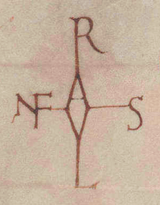
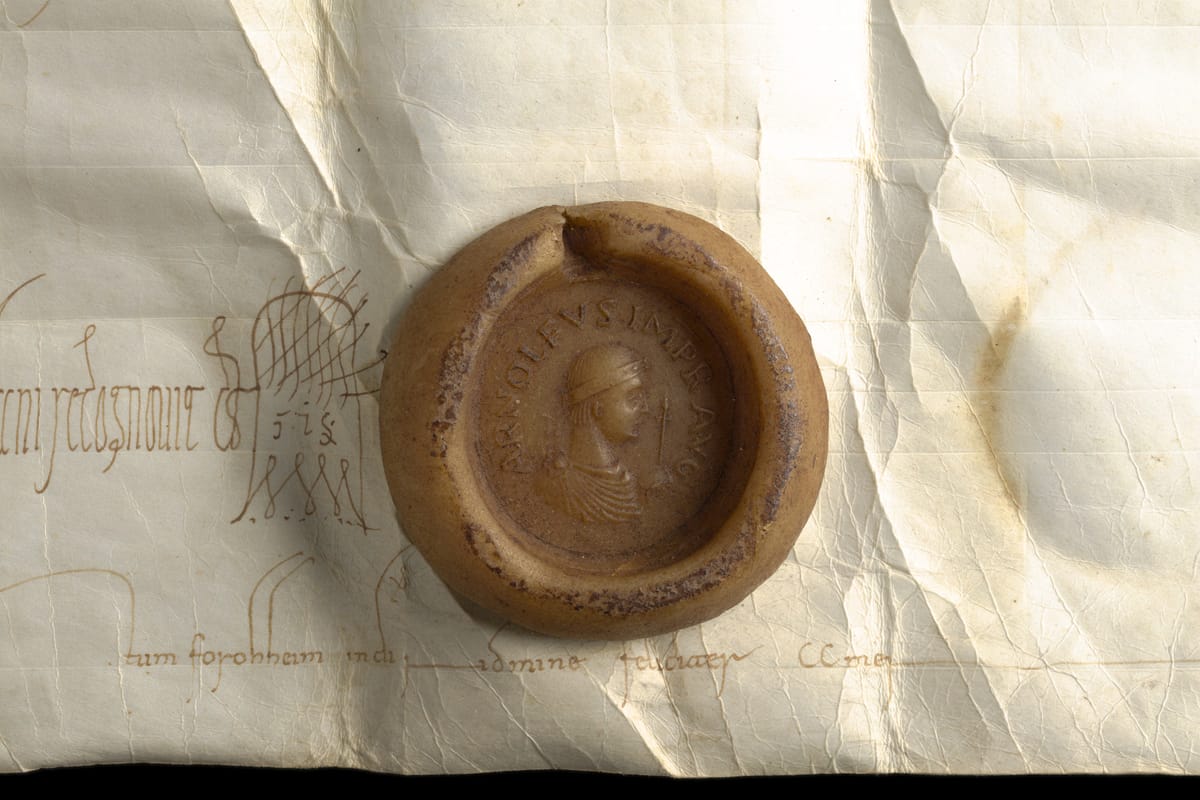
In my dissertation I discussed the royal monogram, which was a visual representation of the king's name and was placed at the end of the charter. Alongside the monogram is another visual representation of the king, the seal, which I never had much to say about in the dissertation. Under the Carolingians adding a seal was entirely a royal prerogative: it was one way of denoting that a document was "royal."[1] The previous dynasty, the Merovingians, may have used Roman coinage as the precedent for their seals, and the sealing of documents likely had its roots in late antique documentary culture.[2] The late Roman world had a tradition of having documents publicly validated, which were recorded in the gesta municipalia. This didn't survive into the early middle ages, but features of public validation did.[3] By the late ninth century this had undergone further changes, the seal looked different. Within the East Frankish royal family there was experimentation with the images on the seals, each king having different variations.[4]
This variation was my first port of call: I wanted to see how Arnulf's seals compared to his predecessors. But I had one time heard that Louis the Child reused the seal of Louis the German. So I shifted focus and pulled up the charters of Louis the Child and Louis the German from the St. Gall digital archive and started comparing, hoping I could confirm that Louis the Child did reuse the same seal. Sure enough, I found two that looked very similar: a charter from 875 and 901.
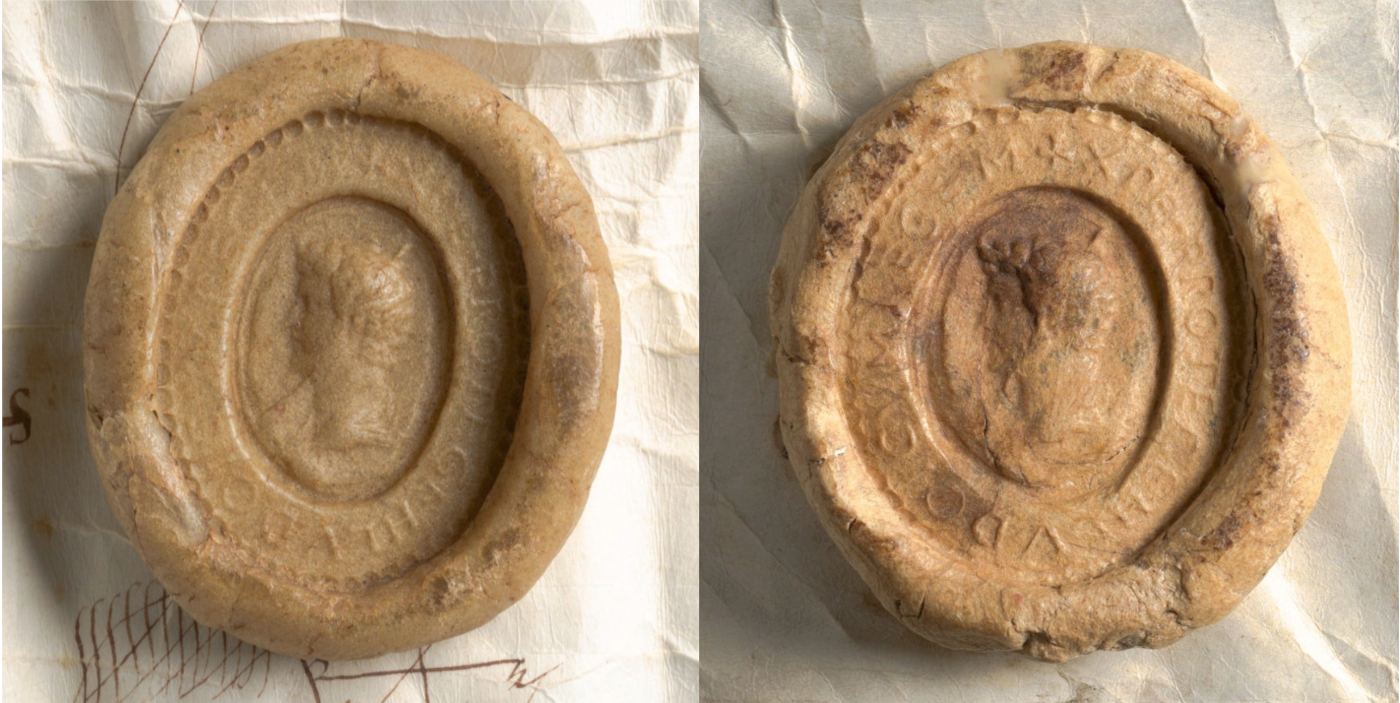
This is exactly the kind of thing that editors love to mention in their editions, so I could quickly check in Theodor Schieffer's 1960 edition of Louis the Child's charter. Schieffer, citing earlier works on seals, notes that it is the same seal.[5]
Seals, Roman Emperors, and Unanswered Questions
The seal was based on an antique gem, a portrait bust of the Emperor Hadrian most likely, and it was damaged at one point before being repaired. The crack left by that repair can still be seen on both seals if you look closely. It is possible the original looked something like this, an intaglio of the emperor Hadrian now found in the Museo archeologico nazionale in Florence.
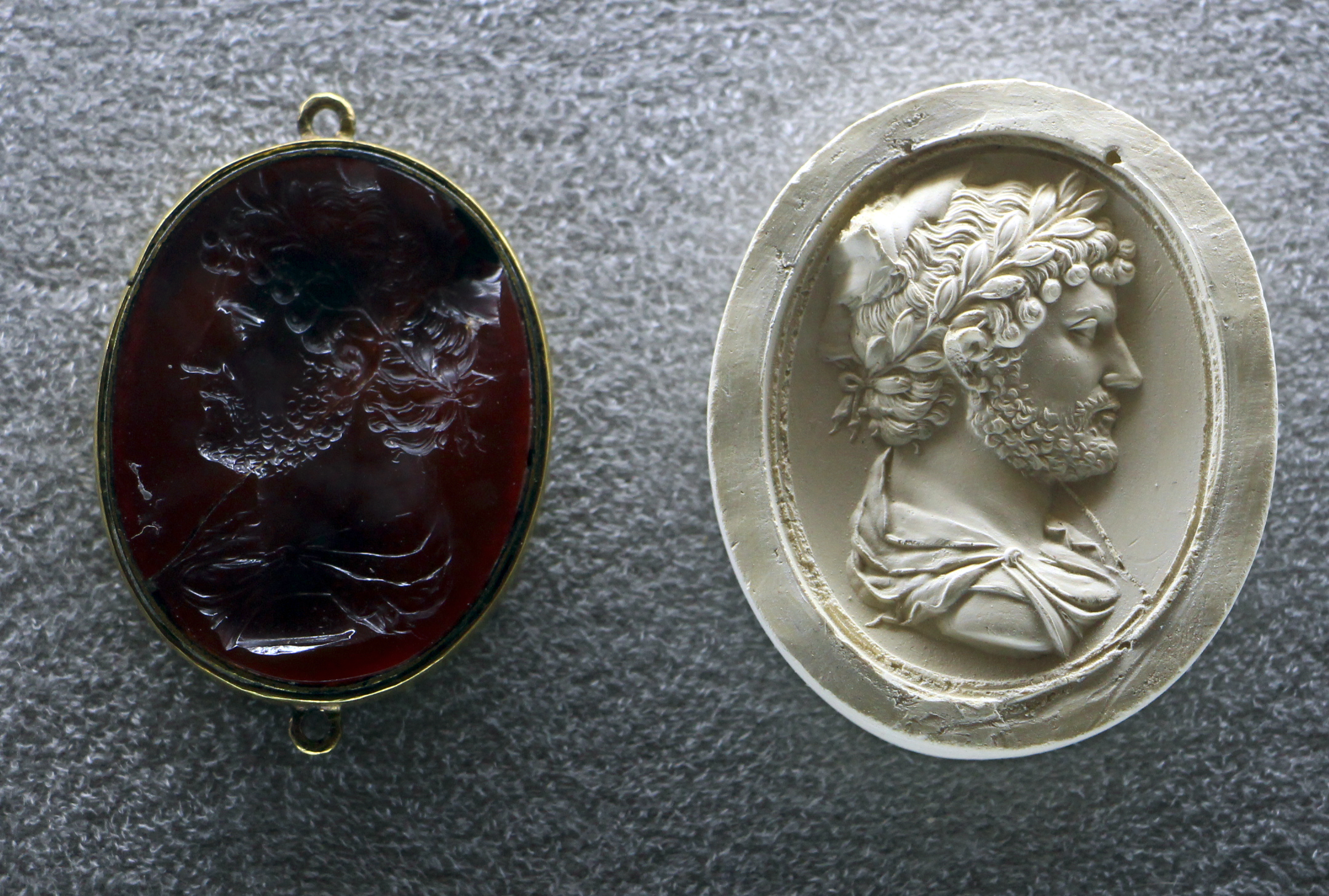
These types of gems could form the matrix for seals, indeed one of Arnulf's early charters seems to contain a seal using an antique gem as well. The seal is quite damaged, so it is not as nicely preserved as the others.
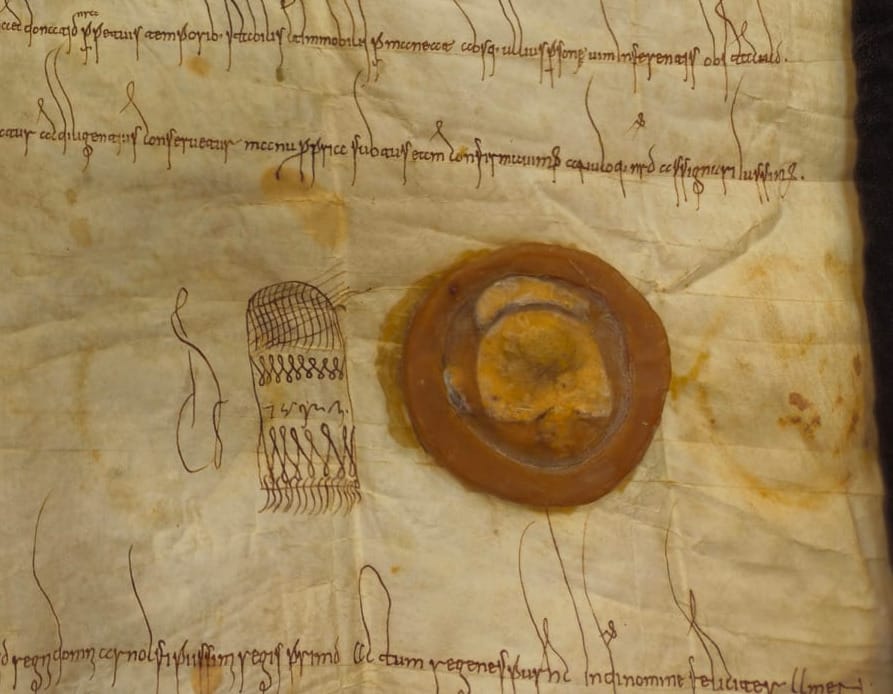
There also seems to have been a revival of this type of art in the period as seen in the Saint-Denis Crystal and the small gem, perhaps part of a seal, of Lothar II in the Ottonian "Cross of Lothar."
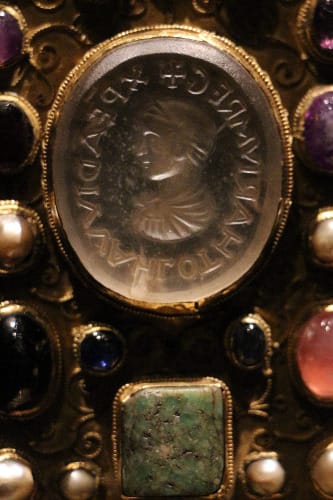
Even Radbod, the archbishop of Trier and member of Arnulf's court, had a gem seal, now in the Hamburg Museum für Kunst & Gewerbe. Yet the depth of the etching can perhaps indicate the differences in usage, with Radbod's gem not meant to make impressions in wax like Lothar II's.
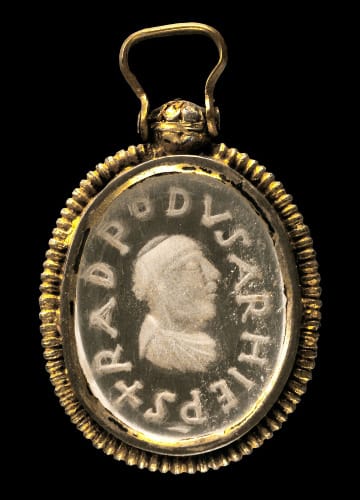
Naturally, one can easily connect this revival and interest in Roman intaglio to a broader Carolingian interest in Rome and Romanitas.[6] But the existence of the intaglio also suggests collections of Roman objects at the Carolingian court. Louis the Pious reused a Roman sarcophagus, did they know what they had?[7] Genevra Kornbluth suggests that in terms of gems, Carolingian artists were careful and sophisticated in their use of models.[8] The depiction of the ruler was not meant to represent the king's actual appearance, but instead depict their official capacity and to communicate their status.[9]
Conclusion
What should we make of all this, then? Reusing a seal suggests continuity, but to a very specifically elite audience who is viewing and creating charters. Charters were highly targeted documents, and unless you were examining it closely, you would not have an easy time distinguishing much of their visual forms. Further, Louis the Child had three different seals while Arnulf had five. The final seal of Arnulf corresponded to him becoming emperor in 896, requiring a new seal to reflect the imperial title, but why change the other times?
Broadly, however, it seems that there was one seal in use from December 887 to July 892, then a new seal was introduced in January 893, but not used regularly until February, at which point it was the main seal until the imperial seal in 896.[10] What happened between July 892 and January 893? One potential clue is the series of victories Arnulf won over the Moravians on the eastern frontier. It is as the same time we begin to see Arnulf described as "the most invincible king" in the signum line of his charters. I don't have a more developed answer (this was a digression after all!) but hopefully this offers a glimpse into how historians (or rather, me) work behind the scenes. Rarely does a project evolve exactly how one expects, but follows the evidence into new and interesting directions. Before writing this I really didn't think much about the seals on charters, but now I have a whole host of new questions that need answering! The joy of being a historian is precisely that it is almost impossible to run out of things to investigate.
Thanks for reading Among the Ruins! If you haven’t subscribed, please do so below and you can have these posts delivered right to your inbox!
- B. Bedos-Rezak, "Ritual in the Royal Chancery: Text, Image, and the Representation of Kingship in Medieval French Diplomas (700-1200)," in H. Durchhardt, R. Jackson and D. Sturdy (eds), European Monarchy: Its Evolution and Practise from Roman Antiquity to Modern Times (Stuttgart, 1992), pp. 27-40. P. Worm, “From Subscription to Seal: The Growing Importance of Seals as Signs of Authenticity in Early Medieval Royal Charters,” in P. Schulte, M. Mostert, and I. van Renswoude (eds), Strategies of Writing: Studies on Text and Trust in the Middle Ages. Papers from “Trust in Writing in the Middle Ages” (Utrecht, 28-29 November 2002) (Turnhout, 2008), pp. 68-83.
- A. Stieldorf, “Gestalt und Funktion der Siegel auf den merowingischen Königsurkunden,” Archiv für Diplomatik, Schriftgeschichte Siegel- und Wappenkunde 47–48 (2002): 133–66.
- See W. Brown, "The gesta municipalia and the Public Validation of Documents in Frankish Europe," in W. Brown et al. (eds), Documentary Culture and the Laity in the Early Middle Ages (Cambridge, 2013), pp. 95-124. M. Innes, "Archives, Documents and Landowners in Carolingian Francia," in Brown, Documentary Culture, pp. 152-188.
- See H. Keller, "Zu den Sigeln der Karolinger und der Ottonen. Urkunden als "Hoheitszeichen" in der Kommunikation des Königs und seiner Getreuen," Frühmittelalterliche Studien 32 (1998): pp. 400-441 at pp. 410-413.
- See the edition of Louis the Child's charters, T. Schieffer (ed.), Die Urkunden Zwentibolds und Ludwigs des Kindes (Berlin, 1960), p. 93.
- The literature on this is truly gargantuan, I really like this recentish article: R. Kramer and C. Gantner, "Lateran Thinking: Building an Idea of Rome in the Carolingian Empire," Viator 47, no. 3 (2016): pp. 1-26. Here are some other things to read: L. Sarti, Orbis Romanus: Byzantium and the Legacy of Rome in the Carolingian World (Oxford, 2024). R. McKitterick, "Transformations of the Roman Past and Roman Identity in the Early Middle Ages," in C. Gantner, R. McKitterick, and S. Meeder (eds), The Resources of the Past in Early Medieval Europe (Cambridge, 2015), pp. 225-244.
- G. Noga-Banai, "The Sarcophagus of Louis the Pious at Metz: A Roman Memory Reused," Frühmittelalterliche Studien 45, no. 1 (2011): pp. 37-50. See also G. Kornbluth, "Roman Intaglios Oddly Set: The Transformative Power of the Metalwork Mount," in C. Entwistle and N. Adams (eds), Gems of Heaven: Recent Research on Engraved Gemstones in Late Antiquity, c. AD 200-600 (London, 2011), pp. 248-257.
- G. Kornbluth, "The Seal of Lothar II: Model and Copy," Francia 17 (1990): pp. 55-68 at p. 62.
- See P. Schramm, Die Deutschen Kaiser und Könige in Bildern ihrer Zeit 1 (Leipzig, 1928), pp. 4-11. However Schramm was deeply influenced by his own political ideas of the past, see E. Garrison, "Ottonian Art and Its Afterlife: Revisiting Percy Ernst Schramm's Portraiture Idea," Oxford Art Journal 32, no. 2 (2009): pp. 205-222.
- For the real seal freaks out there, it is possible the first charter to use the imperial seal was D A 141, see O. Posse, Die Siegel der Deutschen Kaiser und Könige von 751 bis 1806 vol. 1 (Dresden, 1909), p. 11 and Table 5, nos. 6 and 6.


_09_cammeo_di_augusto.jpg?ref=among-the-ruins.ghost.io)