What is an Academic Field? Some Positive Reflections
Hello! I received my PhD in Medieval History in May 2025 and am using my expertise to educate interested people in the Middle Ages and the process of creating history. Subscribing as either a free or paid member will help you go from an enthusiast to someone who understands how and why historians work the way they do.
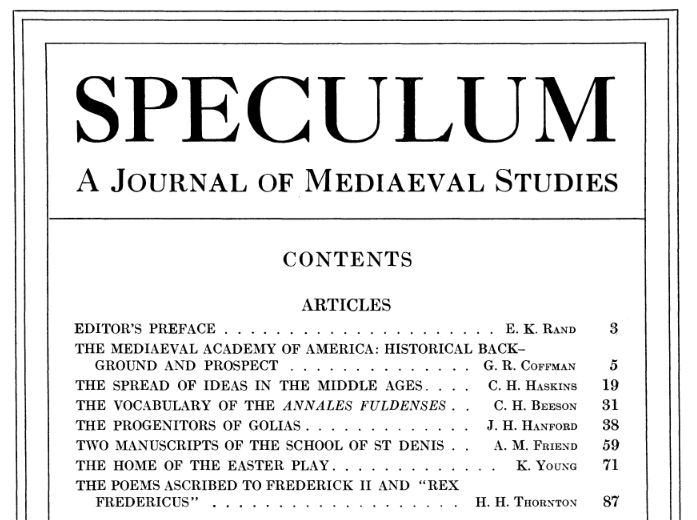
I recently had occasion to look through the old issues of Speculum, one of the most prominent journals for medieval history in the United States. As I perused issues from the 1930s and 1940s I recognized almost none of the names. At first this caused a moment of existential panic: will anything I do be remembered? Is there any point to all this researching and writing if it will be forgotten? But it also made me think about the rapidly disintegrating job market for historians, but especially premodern historians. I don't plan to get into the reasons for that (which are not simply demand issues), but instead thinking about what an academic field actually is and what it can be. Things have been a bit grim all around lately, so consider this my attempt to be a bit more positive.
The Many Fields of a Single Scholar
Academics love to talk about "their" discipline or "their" field but it may not be obvious what that actually means. In essence, the field is the collective of scholars working on an academic topic. Our story largely begins in the late nineteenth century, with an increasing number of history departments and historians. Over the course of the nineteenth century the discipline of history had become increasingly professionalized, and soon organizations began to spring up specifically dedicated to promoting the research and interests of these scholars.[1]
These organizations, like the American Historical Association, in theory represent a whole host of different types of historians. That is, scholars can belong to multiple different fields simultaneously. I am a historian but I specialize in politics, particularly medieval politics of the ninth century, so there are quite a few "fields" that I call home even if I still am foremost a medieval historian. Academic fields often develop their own scholarly methods, language, and tools that situate someone as a member of that field. While historians all share a broad commonality, political historians will operate differently from cultural historians, and this division can be extended in all sorts of ways. Fields are not static, however. Much has changed in how historians work over the last hundred or so years. That is not, necessarily, a bad thing, but shows how it is through the accumulation of research and ideas that our knowledge is advanced.
Yet we need not throw out the scholars of old, who are often held up as strawmen for approaches we don't like anymore. They had clear blindspots (the presence of women in the field and the sources, for example) but their writings contain a lot more nuance than they are often given credit for. The field of medieval studies, as it exists, is still too exclusionary. Structural issues preclude participation from poor scholars, those without institutional affiliation, or from parts of the world not typically "associated" with study of the Middle Ages. This is not a new phenomenon, but there are positive signs for change. The field of the future should continue to fix these flaws. Of course, there are other problems I could mention, but I am trying to focus on the positives here.
If much of the lifeblood of the field was in journals and conferences, I am not sure if that is the future. In an earlier period the conference was a place where scholars from all over could come, giving form to the field. To rephrase the words of Timothy Reuter discussing medieval assemblies, it was "through embodying itself as [a conference]" that the community comes to exist.[2] Yet this never encompassed everyone, and today with the advent of hybrid conferences, still doesn't. Especially as costs associated with conferences continue to rise and institutional budgets dwindle, the field is increasingly untethered from these gatherings. That being said, they are still (in my opinion, some people hate conferences which is fine!) the place I feel most connected to the wider academic world.
Academic Fields as Community
Thinking back to those scholars in the 1920s (and even earlier!) who advanced our knowledge, reveals that the actual impact of our research is not, generally, forever. But instead it contributes something to the community around us in the present. I stand at the end of, and also within, a long line of historians, who made my scholarly existence possible. Looking through the old issues of Speculum, I can see the webs that connect these scholars to me. Whether it be where I studied (Cambridge or Catholic University), people I have read (for the older issues) and then people I have met (in more recent issues). I certainly hope my scholarship stands the test of time in some way, but if not, I am content if I am part of the train of scholars that brought the conversation to where it is in the future. As we look out on an academic landscape that is increasingly barren and devalued, community is the part that remains alive. I can read a draft for a colleague, receive a soon-to-be published piece from another, and send a quick email to a third asking for their thoughts on a particularly thorny problem in the course of a single afternoon!
What a field represents (in my positive view) is a shared desire to see knowledge expanded. In 1927 the Bollandist society evidently ran into financial troubles, prompting the nascent Medieval Academy of America to internally raise $3,550 ($66,000 in today's money) so that the society's series, published since 1643, could continue without interruption.[3] Nowadays, the Atlantic does not pose nearly as large a barrier for collaboration as it once did, with the advent of email and Zoom. The field now exists across space and with a rapidity that was impossible in the early twentieth century. The pace of academic life has changed, but like in the 1920s it is increasingly driven by decentralized (and deinstitutionalized) networks of scholars.
Academic fields fundamentally depend on connection. Despite the impression of the hermetic scholar, toiling away forever on their book, much scholarly activity relies on connection and collaboration even if it is unacknowledged. Thinking back to Twitter, and now Bluesky (which you can find me here), it has been immensely useful for scholarly connection and research opportunities. Naturally, some of the Discourse™ is insufferable and annoying, but on the whole it lets me share my own work while boosting and being engaged with others. If the field is to survive into the future, I think it will be increasingly in digital spaces. Very few things inspire me more than seeing all the wonderful work that continues to be produced. Some of this is being done under incredibly, and increasingly, precarious conditions by graduate students or otherwise underpaid scholars.
If the goal of a field is to expand our knowledge, then it does not matter who is part of it and where it takes place. When Hincmar of Reims wanted to describe the early medieval palace, he remarked that it was called such not because of its walls but because "reasonable men inhabit it."[4] That is, it was the individuals that gave the community its shape, not the physical space of it. I won't be so brash as to give a sort of Latin name for this, like the palatini that inhabited the medieval palace of Charlemagne, but there is something important in this idea. A field is not defined by any one institution, but by the collective. Working over space, but also across time, brings out new ideas and pushes us forward. At its core I do what I do because if I have only one life, then I want to invest it in something I am interested in. I love studying the past and talking about it. I only hope my (meager)[5] contributions are valuable to those in the present.
Thanks for reading Among the Ruins! If you haven’t subscribed, please do so below and you can have these posts delivered right to your inbox! Sharing my work on social media is also greatly appreciated!
- See "Prefatory Note," The English Historical Review 1, no. 1 (1886): 1-6 and D. Van Tassel, "From Learned Society to Professional Organization: the American Historical Association, 1884-1900," The American Historical Review 89, no. 4 (1984): 929-956.
- T. Reuter, "Assembly Politics in Western Europe from the Eighth Century to the Twelfth," in J. Nelson (ed.), Medieval Polities and Modern Mentalities (Cambridge, 2006), pp. 193-217 at p. 207, reprinted from P. Linehan and J. Nelson (eds), The Medieval World (London, 2001), pp. 432-450.
- MAA Archives Corp. Meeting 3, "Minutes of the Corporation Meeting 28 April 1928", p. 5.
- W. Hartmann (ed.), Die Konzilien der Karolingischen Teilreiche 843-859, MGH Concilia 3, p. 413: Palatium enim regis dicitur propter rationabiles homines inhabitantes, et non propter parietes insensibiles sive macerias.
- I would be remiss not putting in a little medieval-style humility.